Содержание
АКТУАЛЬНО
E-mail: finance-journal@mail.ru
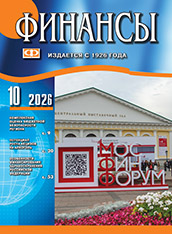
Представлена информация о состоявшимся 8 сентября Московском финансовом форуме (МФФ-2026), организаторами которого были Министерство финансов Российской Федерации и Правительство Москвы. В работе МФФ-2026 приняли участие более 2 500 делегатов, включая представителей федеральных и региональных органов власти, финансовых институтов, бизнеса, научного и экспертного сообщества, общественных организаций и объединений власти. Вот уже 11-й год на Московском финансовом форуме специалисты обсуждают текущие проблемы и перспективы, ищут пути решения, оценивают дальнейшие перспективы. В этом году в ходе МФФ-2026 проходили 16 сессий и пленарное заседание, в котором участвовали Министр финансов РФ А.Г. Силуанов и мэр Москвы С.С. Собянин. О важности и значимости МФФ-2026 можно судить по тому, что в ходе пленарного заседания было представлено видеообращение Председателя Правительства Российской Федерации М.В. Мишустина к участникам Форума, в котором было отмечено, что за годы работы Московский финансовый форуме стал одной из ключевых площадок для профессионалов в сфере управления инвестициями, фондами и капиталами. В ходе пленарного заседания, проходившего по девизом «Устойчивая финансовая система – основа развития страны», учитывая, что Россия каждый год сталкивается с новыми вызовами не только на уровне Федерации, но и на уровне регионов, а задача финансистов – находить решения и искать новые возможности, разговор шел о том, как с этими задачами справляются Минфин России и Правительство Москвы. В ходе дискуссии также были затронуты вопросы цифровизация государственного управления, финансовой и других отраслей, применение искусственного интеллекта. Также обсуждали вопросы помощи участникам специальной военной операции и их семьям, новым регионам России. А.Г. Силуанов и С.С. Собянин выразили мнение, что главными в настоящий момент являются наша победа и, соответственно, задача обеспечить такое развитие экономики, которое позволит обеспечить эту победу.
В ходе 16 сессий на МФФ-2026 проходили жаркие дискуссии по самым актуальным проблемам современных финансов, был охвачен широкий круг вопросов, в том числе вопросы сбал ансированности региональных бюджетов, выход компаний с государственным участием на публичный рынок, роль государственных средств на денежном рынке, использование искусственного интеллекта и криптовалют, проблемы борьбы с теневой занятостью.
О значимости МФФ-2026 также свидетельствует тот факт, что во всех сессиях активно участвовали заместители министра финансов РФ, заместители руководителя ФНС России, руководитель и заместители руководителя Федерального казначейства.
Ключевые слова: сбалансированность регионального бюджета, искусственный интеллект, цифровизация государственного управления, компания с государственным участием, криптовалюта, «обеление экономики», финансовая грамотность.
РЕГИОНАЛЬНЫЕ ФИНАНСЫ
Т.Г. Кадникова, доцент Института экономики и права Петрозаводского государственного университета, кандидат экономических наук, доцент
E-mail: goldsun@mail.ru
В условиях усиления дифференциации социально-экономического развития субъектов Российской Федерации, трансформации межбюджетных отношений и роста долговой нагрузки регионов актуализируется совершенствование подходов к оценке бюджетной безопасности. Несмотря на наличие исследований бюджетной и долговой устойчивости, вопросы комплексной оценки способности региональных бюджетов противостоять угрозам остаются дискуссионными. Цель исследования – развитие методического подхода к оценке бюджетной безопасности субъекта Российской Федерации на основе системы показателей финансовой автономии, устойчивости доходной базы и долговой устойчивости с апробацией на материалах Республики Карелия. Методологическую основу составили методы сравнительного, экономико-статистического и корреляционно-регрессионного анализа. Научная новизна заключается в формировании комплексной системы оценки бюджетной безопасности региона, объединяющей показатели финансовой автономии, устойчивости доходов, долговой нагрузки, качества бюджетного планирования и бюджетной обеспеченности для выявления состояния региональных финансов и ключевых направлений формирования бюджетных рисков.
Ключевые слова: бюджетная безопасность, бюджетная устойчивость, финансовая автономия, долговая устойчивость, региональные финансы, Республика Карелия, бюджетная обеспеченность, региональный бюджет.
Н.Е. Барбашова, старший научный сотрудник Института прикладных экономических исследований РАНХиГС (г. Москва), кандидат экономических наук
E-mail: barbashova-ne@ranepa.ru
Российские регионы сталкиваются с возрастающей нагрузкой на здравоохранение в части обеспечения конституционных гарантий по предоставлению гражданам общедоступной и бесплатной медицинской помощи. В связи с этим приобретает актуальность вопрос о возможности дополнительного обеспечения территориальной программы государственных гарантий в пределах собственных финансовых ресурсов регионов. В данной статье рассмотрен опыт субъектов Российской Федерации, на постоянной основе использующих механизм бюджетного софинансирования территориальных программ обязательного медицинского страхования. На основе анализа региональной практики выработаны рекомендации по выбору подходов к дополнительному финансированию медицинской помощи из бюджетов в зависимости от цели и ожидаемых результатов. Показано, что расширенное финансирование государственных гарантий может быть эффективно даже в условиях жестких бюджетных ограничений с учетом приоритизации расходов.
Ключевые слова: здравоохранение, региональный бюджет, межбюджетные трансферты, приоритизация расходов.
К 100-ЛЕТИЮ ЖУРНАЛА «ФИНАНСЫ»
E-mail: finance-journal@mail.ru
Материалы о бюджете, бюджетной системе и межбюджетных отношениях публиковались в журнале на протяжении всего столетия. Среди многочисленных статей важное место занимает статья профессора Н.Н. Ровинского, написанная в суровый для страны 1942 г., в которой проанализированы 25 лет развития бюджетной системы СССР. Важно, что это развитие автор показал через советские конституции, которые «представляют собой итог пройденного советским государством пути». Н.Н. Ровинский в своей статье писал и о постоянной заботе правительства об устойчивости местных бюджетов, укреплении доходов местных бюджетов. В качестве иллюстрации этого представлены данные о расходных назначениях на 1925–1926 и 1926–1927 гг., которые приведены в статье И. Пергамента, опубликованной в журнале в 1927 г.
Ключевые слова: бюджетная система, общегосударственный бюджет, местный бюджет, Конституция СССР, декрет ВЦИК, налоговая реформа 1931 г., дотации, Положение о местных финансах.
НАЛОГИ: ТЕОРИЯ И ПРАКТИКА
С.В. Ануреев, профессор кафедры общественных финансов Финансового университета при Правительстве Российской Федерации, доктор экономических наук
E-mail: anureev@bk.ru
Поступления акцизов и налога на добавленную стоимость на алкоголь составляют порядка 1,5% доходов консолидированного бюджета РФ в 2025 г., а в СССР было 14% в 1984 г. Первая причина такого разрыва связана с сильно опережающим ростом средних зарплат относительно цен водки и пива, изменений их доступности в 10 и 3 раза. Поэтому предлагается за несколько лет удвоить минимальную розничную цену (МРЦ) алкоголя, сообразно увеличить акциз, вернуть тем самым доступность этих напитков в 2005 и 2015 гг. Предлагается такое решение по МРЦ и для пива вместе с предложением лицензирования его продаж, поскольку на пиво и пивные напитки приходится 82% продаж алкоголя в оригинальных литрах. Другая проанализированная причина заключается в росте числа точек продаж алкоголя в 4 раза относительно 1985 г., когда издержки торговли стали сопоставимы с доходами государства, а 85% издержек постоянны. Предлагается сократить в 2 раза число точек продаж алкоголя за счет донастройки лицензирования, снизить тем самым издержки торговли без значимого падения выручки. Реализация этих предложений может увеличить доходы бюджета от алкоголя с 1,1 до 2,8 трлн руб., с разницей масштаба трети дефицита федерального бюджета 2025 и 206 гг.
Ключевые слова: акцизы, лицензирование, общественный контроль, доходы от продажи алкоголя, минимальная розничная цена.
В.В. Громов, старший научный сотрудник Центра макроэкономического анализа и прогнозирования Института экономики Российской академии наук (ИЭ РАН), кандидат экономических наук
E-mail: gromov-vv@inecon.ru
Преобразования, наблюдаемые в сфере налоговых отношений, предопределены задачей укрепления доходной части бюджетной системы. Этот процесс сочетается с принятием мер, которые призваны сбалансировать, хотя бы частично, рост фискальной нагрузки на российскую экономику через адресные инструменты ее снижения. В сфере подоходного налогообложения ими стали стандартные налоговые вычеты на детей, воплощающие на практике социальную функцию налоговой системы. Наряду с увеличением предельного размера их донастройка подразумевала расширение интервала доходов, позволяющего пользоваться правом на уменьшение налоговой базы. На основе анализа данных параметров в статье выявляется функциональное назначение налоговых вычетов на детей, их концептуальная трансформация и показана тенденция к сужению социальной функции.
Ключевые слова: бедность, налоговая нагрузка, налоговая политика, НДФЛ, регрессивное налогообложение, справедливость налогообложения, стандартный налоговый вычет.
А.А. Пугачев, доцент кафедры финансов и кредита, старший научный сотрудник Управления научных исследований и инноваций Ярославского государственного университета им. П.Г. Демидова, кандидат экономических наук, доцент
E-mail: andrxim@yandex.ru
Снижение уровня экономического неравенства в России является одной из национальных целей развития. Для ее достижения перспективным является формирование и развитие экосистемы налогового регулирования сглаживания экономического неравенства физических лиц. Экосистема включает инструменты подоходного, имущественного и косвенного налогообложения во взаимосвязи с неравенством доходов, богатства и потребления соответственно, а также налоговое администрирование и контроль. Экосистема предусматривает комплексность воздействия налогового механизма на факторы или причины неравенства, а не на его симптомы, а также гибкость налоговых инструментов, возможность их адаптации к современной трансформации неравенства.
Ключевые слова: экосистема, экосистемный подход, экономическое неравенство, налоговый механизм, налоговые инструменты, налоговое регулирование, сглаживание неравенства.
ФИНАНСЫ СОЦИАЛЬНОЙ СФЕРЫ
Д.А. Артеменко, профессор кафедры общего и проектного менеджмента Факультета «Высшая школа управления» Финансового университета при Правительстве Российской Федерации, главный научный сотрудник Института экономики РАН, доктор экономических наук
E-mail: daartemenko@fa.ru
О.В. Обухова, начальник отдела научных основ экономики здравоохранения Центрального научно-исследовательского института организации и информатизации здравоохранения Минздрава России, кандидат политических наук
E-mail: obuhova@mednet.ru
Ф.Н. Кадыров, советник директора Центрального научно-исследовательского института организации и информатизации здравоохранения Минздрава России, заслуженный экономист Российской Федерации, доктор экономических наук
E-mail: kadyrov@mednet.ru
Финансирование здравоохранения является сферой пристального внимания аналитиков и одновременно предметом дискуссий. Несмотря на то что показатели финансирования здравоохранения отражаются в официально публикуемых бюджетах, простое оперирование цифрами не может обеспечить реальную оценку финансового благополучия отрасли. Проблема усугубляется не только наличием различных источников финансирования: бюджеты различного уровня, средства государственных внебюджетных фондов, прежде всего обязательного медицинского страхования (ОМС), а также средства граждан и организаций, но и наличием сложной системы межбюджетных трансферов и др. Поэтому крайне важным представляется комплексный анализ динамики, структуры и приоритетных направлений расходов на здравоохранение в контексте достижения национальных целей развития.
В статье представлены динамика объемов финансирования здравоохранения по уровням бюджетной системы, темпы роста расходов на здравоохранение, оценка финансовой обеспеченности системы обязательного медицинского страхования и другие показатели развития отрасли. Как показало исследование, акцент на ОМС в качестве основного источника финансирования оказался оправданным. Привязка основной части страховых взносов к фонду оплаты труда обеспечила стабильное ежегодное превышение фактических доходов Федерального фонда обязательного медицинского страхования над запланированными (утвержденными), что привело к сглаживанию влияния инфляционных факторов. В заключении статьи авторами предлагаются меры по совершенствованию финансирования здравоохранения.
Ключевые слова: финансирование здравоохранения, расходов на здравоохранение, обязательное медицинское страхование, средства государственных внебюджетных фондов, федеральные проекты здравоохранения.
НАУЧНЫЕ ИССЛЕДОВАНИЯ АСПИРАНТОВ И СОИСКАТЕЛЕЙ
В.А. Демидов, аспирант Института государственной службы и управления Президентской академии (г. Москва)
E-mail: finance-journal@mail.ru
В статье рассмотрены санкции, их виды, цели, способы и правовые основания применения. Сделан вывод о незаконности введения санкций против России. Отмечено, что санкционное давление оказывается на международные отношения, научно-образовательные программы, финансовую сферу, производственные и торговые связи. Приведены меры противодействия санкционному давлению. Сделан вывод о необходимости создания специальной цифровой платформы для анализа угроз деятельности хозяйствующих субъектов и выработки комплекса контрмер по противодействию санкционному давлению.
Ключевые слова: санкционное давление, хозяйствующий субъект, меры реагирования и поддержки, специальная цифровая платформа.
Content
TOPICAL
E-mail: finance-journal@mail.ru
Information on the Moscow Financial Forum (MFF-2026), held on September 8, was organized by the Ministry of Finance of the Russian Federation and the Moscow Government. The MFF-2026 was attended by more than 2,500 delegates, including representatives of federal and regional authorities, financial institutions, business, the scientific and expert community, public organizations and government associations. For the 11th year now, at the Moscow Financial Forum, experts have been discussing current problems and prospects, looking for solutions, and assessing future prospects. This year, 16 sessions and a plenary session were held during the MFF-2026, in which the Minister of Finance of the Russian Federation A.G. Siluanov and Moscow Mayor S.S. Sobyanin. The importance and significance of the MFF-2026 can be judged by the fact that during the plenary session a video message from the Prime Minister of the Russian Federation M.V. Mishustin to the Forum participants, in which it was noted that over the years the Moscow Financial Forum has become one of the key platforms for professionals in the field of investment management, funds and capital. During the plenary session, which was held according to the motto "A stable financial system is the basis for the country's development," given that every year Russia faces new challenges not only at the Federation level, but also at the regional level, and the task of financiers is to find solutions and look for new opportunities, the conversation was about how the Ministry of Finance of Russia and the Government of Moscow are coping with these tasks. During the discussion, issues of digitalization of public administration, financial and other industries, the use of artificial intelligence were also touched upon. They also discussed issues of assistance to participants in a special military operation and their families, new regions of Russia. A.G. Siluanov and S.S. Sobyanin expressed the opinion that the main thing at the moment is our victory and, accordingly, the task of ensuring such a development of the economy that will ensure this victory.
During 16 sessions, the MFF-2026 held heated discussions on the most pressing problems of modern finance, covered a wide range of issues, including the balance of regional budgets, the entry of companies with state participation into the public market, the role of public funds in the money market, the use of artificial intelligence and cryptocurrencies, problems of combating shadow employment.
The importance of the MFF-2026 is also evidenced by the fact that all sessions were actively attended by Deputy Ministers of Finance of the Russian Federation, Deputy Heads of the Federal Tax Service of Russia, Head and Deputy Heads of the Federal Treasury.
Keywords: balance of the regional budget, artificial intelligence, digitalization of public administration, a company with state participation, cryptocurrency, "whitewashing of the economy," financial literacy.
T.G. Kadnikova, Associate Professor, Institute of Economics and Law, Petrozavodsk State University, Candidate of Economic Sciences, Associate Professor
E-mail: goldsun@mail.ru
In the context of increasing socio-economic disparities among the constituent entities of the Russian Federation, transformations in intergovernmental fiscal relations, and growing regional budget debt burdens, the improvement of approaches to assessing budget security has become increasingly important. Despite existing studies on regional budgetary and debt sustainability, issues related to a comprehensive assessment of the ability of regional budgets to withstand internal and external threats remain debatable. The aim of the study is to develop a methodological approach to assessing the budget security of a constituent entity of the Russian Federation based on a system of indicators reflecting financial autonomy, revenue base sustainability, and debt sustainability, with its application to the Republic of Karelia. The methodological framework includes comparative, economic-statistical, and correlation-regression analysis methods. The scientific novelty lies in the development of a comprehensive system for assessing regional budget security that integrates indicators of financial autonomy, revenue sustainability, debt burden, budget planning quality, and budget provision to identify the current state of regional finances and key areas of budget risk formation.
Keywords: fiscal security, regional fiscal sustainability, fiscal autonomy, debt sustainability, regional public finance, Republic of Karelia, fiscal capacity, regional budget.
N.E. Barbashova, Candidate of Economic Science, Senior Researcher, Institute for Applied Economic Research, RANEPA (Moscow)
E-mail: barbashova-ne@ranepa.ru
Russian regions are facing an increasing burden on healthcare systems in terms of fulfilling constitutional guarantees to provide citizens with universally accessible and free medical care. In this regard, the issue of supplementary financing for territorial state guarantee programs within the regions’ own financial resources becomes increasingly relevant. This article examines the experience of the constituent entities of the Russian Federation that systematically co-finance territorial compulsory health insurance (CHI) programs. Based on the analysis of regional practices, recommendations are developed for selecting approaches to additional budget funding of medical care, depending on the objectives and expected outcomes. It is demonstrated that expanded financing of state guarantees can be effective even under severe budget constraints when expenditure prioritisation is applied.
Keywords: healthcare, regional budget, interbudgetary transfers, prioritization of expenditures.
TO THE 100TH ANNIVERSARY OF "FINANCE" MAGAZINE
E-mail: finance-journal@mail.ru
Materials on the budget, budget system and inter-budgetary relations were published in the magazine throughout the century. Among the numerous articles, an important place is occupied by an article by Professor N.N. Rovinsky, written in the harsh year for the country in 1942, in which 25 years of development of the budget system of the USSR were analyzed. It is important that the author showed this development through the Soviet constitutions, which "represent the result of the path traveled by the Soviet state." N.N. Rovinsky in his article wrote about the constant concern of the government for the stability of local budgets, strengthening the income of local budgets. As an illustration of this, data on expenditure appointments for 1925-1926 and 1926-1927 are presented, which are given in an article by I. Parchment, published in a journal in 1927.
Keywords: budget system, national budget, local budget, Constitution of the USSR, decree of the All-Russian Central Executive Committee, tax reform of 1931, subsidies, Regulation on local finances.
TAXES: THEORY AND PRACTICE
S.V. Anureyev, Professor, Department of Public Finance, Financial University under the Government of the Russian Federation, Doctor of Economics
E-mail: anureev@bk.ru
Revenues of excise taxes and value added tax on alcohol account for about 1.5% of revenues of the consolidated budget of the Russian Federation in 2025, and in the USSR it was 14% in 1984. The first reason for this gap is associated with a very outstripping growth in average wages relative to the prices of vodka and beer, changes in their availability 10 and 3 times. Therefore, it is proposed to double the minimum retail price (MRC) of alcohol in a few years, to increase the excise tax accordingly, thereby returning the availability of these drinks in 2005 and 2015. Such a solution is proposed for the MRC and for beer along with a proposal to license its sales, since beer and beer drinks account for 82% of alcohol sales in original liters. Another reason analyzed is the 4-fold increase in the number of points of sale of alcohol compared to 1985, when the costs of trade became comparable to government revenues, and 85% of the costs are constant. It is proposed to reduce the number of points of sale of alcohol by 2 times by adjusting licensing, thereby reducing trading costs without a significant drop in revenue. The implementation of these proposals could increase budget revenues from alcohol from 1.1 to 2.8 trillion rubles, with a difference in the scale of a third of the federal budget deficit in 2025 and 206.
Keywords: excise taxes, licensing, public control, income from the sale of alcohol, minimum retail price.
V.V. Gromov, Senior Researcher, Center for Macroeconomic Analysis and Forecasting, Institute of Economics, Russian Academy of Sciences (IE RAS), Candidate of Economic Sciences
E-mail: gromov-vv@inecon.ru
The transformations observed in the field of tax relations are predetermined by the task of strengthening the revenue side of the budget system. This process is combined with the adoption of measures that are designed to balance, at least partially, the growth of the fiscal burden on the Russian economy through targeted tools to reduce it. In the field of income taxation, they became standard tax deductions for children, embodying in practice the social function of the tax system. Along with an increase in the maximum size, their adjustment implied an expansion of the income interval, which makes it possible to exercise the right to reduce the tax base. Based on the analysis of these parameters, the article reveals the functional purpose of tax deductions for children, their conceptual transformation and shows a tendency to narrow the social function.
Keywords: poverty, tax burden, tax policy, personal income tax, regressive taxation, tax fairness, standard tax deduction.
A.A. Pugachev, Associate Professor of the Department of Finance and Credit, Senior Researcher, Department of Research and Innovation, Yaroslavl State University named after P.G. Demidov, Candidate of Economic Sciences, Associate Professor
E-mail: andrxim@yandex.ru
Reducing the level of economic inequality in Russia is one of the national development goals. To achieve this goal, it is promising to form and develop an ecosystem of tax regulation aimed at smoothing out economic inequality among individuals. The ecosystem includes instruments of income, property and indirect taxation in relation to income, wealth and consumption inequality respectively, as well as tax administration and tax control. The ecosystem ensures a comprehensive impact of the tax mechanism on the factors or causes of inequality, rather than on its symptoms, and also provides for the flexibility of tax instruments and the possibility of adapting them to the current transformation of inequality.
Keywords: ecosystem, ecosystem approach, economic inequality, tax mechanism, tax instruments, tax regulation, inequality smoothing.
SOCIAL FINANCE
D.A. Artemenko, Professor, Department of General and Project Management, Faculty of Higher School of Management, Financial University under the Government of the Russian Federation, Chief Researcher, Institute of Economics, Russian Academy of Sciences, Doctor of Economics
E-mail: daartemenko@fa.ru
O.V. Obukhova, Head of the Department of Scientific Foundations of Health Economics of the Central Research Institute for Organization and Informatization of Health of the Ministry of Health of Russia, Candidate of Political Sciences
E-mail: obuhova@mednet.ru
F.N. Kadyrov, Advisor to the Director of the Central Research Institute for Organization and Informatization of Health of the Ministry of Health of Russia, Honored Economist of the Russian Federation, Doctor of Economics
E-mail: kadyrov@mednet.ru
Health care financing is an area of close attention of analysts and at the same time the subject of discussions. Despite the fact that health financing indicators are reflected in officially published budgets, simply operating with numbers cannot provide a real assessment of the financial well-being of the industry. The problem is aggravated not only by the presence of various sources of financing: budgets of various levels, funds from state extra-budgetary funds, primarily compulsory health insurance (CHI), as well as funds from citizens and organizations, but also by the presence of a complex system of interbudgetary transfers, etc. Therefore, a comprehensive analysis of the dynamics, structure and priorities of health spending in the context of achieving national development goals is extremely important.
The article presents the dynamics of the volume of financing of health care by the levels of the budgetary system, the growth rate of health care costs, the assessment of the financial security of the compulsory health insurance system and other indicators of the development of the industry. The study showed that the emphasis on compulsory medical insurance as the main source of funding was justified. The linking of the main part of insurance premiums to the wage fund ensured a stable annual excess of the actual income of the Federal Compulsory Medical Insurance Fund over the planned (approved), which led to a smoothing of the influence of inflationary factors. In the conclusion of the article, the authors propose measures to improve health financing.
Keywords: financing of healthcare, healthcare costs, compulsory health insurance, funds of state extra-budgetary funds, federal healthcare projects.
POSTGRADUATE AND APPLICANT RESEARCH
V.A. Demidov, graduate student of the Institute of Public Administration and Management of the Presidential Academy (Moscow)
E-mail: finance-journal@mail.ru
The article considers sanctions, their types, goals, methods and legal grounds for application. It was concluded that the imposition of sanctions against Russia was illegal. It was noted that sanctions pressure is exerted on international relations, scientific and educational programs, the financial sector, production and trade relations. Measures to counter sanctions pressure are given. It was concluded that it is necessary to create a special digital platform for analyzing threats to the activities of business entities and developing a set of countermeasures to counter sanctions pressure.
Keywords: sanctions pressure, economic entity.